See UTC offsets live for any city
Compare UTC offsets and find overlapping work hours.
What Does UTC Stand For?
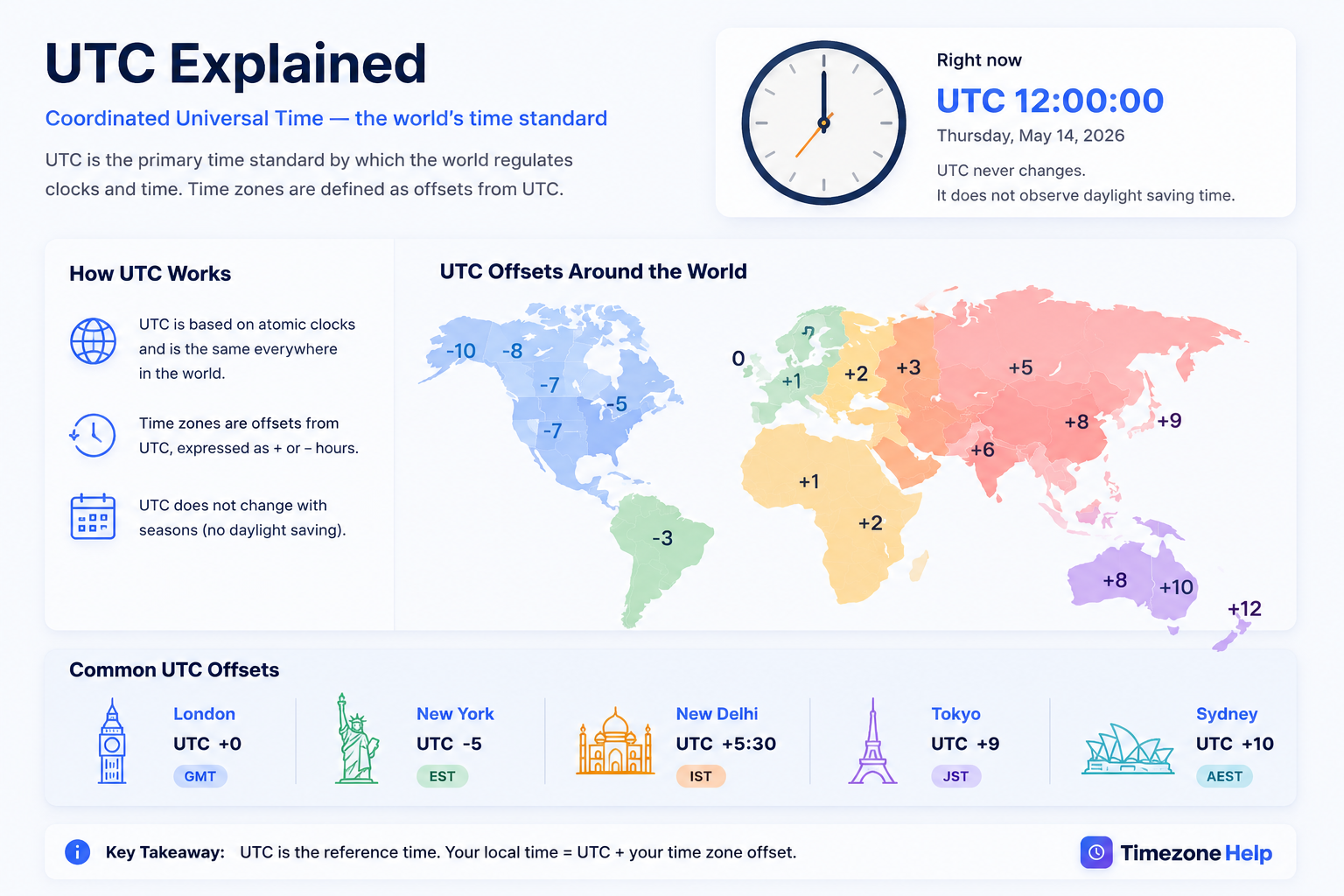
UTC stands for Coordinated Universal Time. It is the primary international time standard used across aviation, the internet, software systems, financial markets, and international communication. UTC does not belong to any country or time zone - it is a neutral, global reference point.
Every time zone on the planet is expressed as an offset from UTC. New York in winter is UTC−5. London in winter is UTC+0. Tokyo is UTC+9. Sydney in summer is UTC+11. All of these exist only in relation to UTC as the anchor.
UTC vs GMT: What's the Difference?
UTC and GMT are often used interchangeably, and for most practical purposes, they can be. But they are not technically identical.
Greenwich Mean Time (GMT)
GMT is a historical time standard based on solar observations at the Royal Observatory in Greenwich, England. It was established in the 19th century to standardise railway timetables across Britain, then adopted as a global standard for navigation and geography. GMT is tied to astronomical observation - the sun's position relative to the Greenwich Meridian.
Coordinated Universal Time (UTC)
UTC was introduced in 1972 as a more precise successor to GMT. Instead of relying on Earth's rotation (which varies slightly), UTC is based on International Atomic Time (TAI) - the average of hundreds of atomic clocks worldwide, accurate to nanoseconds. To keep UTC aligned with the Earth's actual rotation, leap seconds are occasionally added (or theoretically subtracted).
| Property | GMT | UTC |
|---|---|---|
| Based on | Solar observation | Atomic clocks |
| Precision | Variable (Earth's rotation) | Nanosecond accuracy |
| Leap seconds | No | Yes (added periodically) |
| Used in technology | Historically | Universally today |
| Daylight saving | Not affected | Not affected |
| Difference from each other | Less than 1 second | |
For everyday scheduling, the difference between GMT and UTC is irrelevant. When someone says "meet at 14:00 GMT," they mean the same thing as "14:00 UTC." The distinction matters only for scientific, aviation, and software precision contexts.
Major UTC Offsets Around the World
Every time zone is defined as a positive or negative offset from UTC. Here are some key reference points:
| City | Standard Offset | DST Offset | Notes |
|---|---|---|---|
| New York | UTC−5 | UTC−4 | Eastern Time |
| London | UTC+0 | UTC+1 | GMT / BST |
| Dubai | UTC+4 | No DST | GST year-round |
| Mumbai / Delhi | UTC+5:30 | No DST | IST year-round |
| Singapore | UTC+8 | No DST | SGT year-round |
| Tokyo | UTC+9 | No DST | JST year-round |
| Sydney | UTC+10 | UTC+11 | AEST / AEDT |
Why UTC Matters in Software and Technology
If you've ever looked at a server log, database timestamp, or API response, you've almost certainly seen UTC at work. Modern software systems store all times in UTC by default and convert to local time only when displaying to users. This approach has become a near-universal best practice, and for good reason.
Consider what happens without UTC: a timestamp recorded as "3:00 PM" in a database is ambiguous. Is that 3 PM Eastern? Pacific? Does it account for daylight saving? If the server is in Virginia but the user is in California, whose time does "3 PM" mean? UTC eliminates all of this ambiguity.
UTC in Aviation and Navigation
Commercial aviation uses UTC exclusively. Flight plans, air traffic control, weather reports, and NOTAMs (Notices to Air Missions) are all expressed in UTC - often called Zulu time in aviation contexts (because UTC is sometimes suffixed with "Z" for the "zero offset" NATO phonetic designation).
A flight departing "at 14:30Z" departs at 14:30 UTC regardless of what timezone the airport sits in. This eliminates any possibility of confusion between local time zones, which is critical when a flight spans multiple zones or when controllers in different countries are coordinating.
UTC and Daylight Saving Time
One of UTC's most important properties: it never changes. UTC does not observe daylight saving time. It has no seasons, no spring-forward, no fall-back. It is the same at every moment of every year.
When a country observes daylight saving, what changes is the offset between that country's local time and UTC - not UTC itself. So when New York shifts from UTC−5 (EST) to UTC−4 (EDT) in March, UTC hasn't moved at all. New Yorkers have simply chosen to call 06:00 UTC "2 AM" instead of "1 AM" for the summer.
This constancy is why UTC is so valuable for coordination. A meeting scheduled at 14:00 UTC is 14:00 UTC regardless of whether any participant's country is observing DST that day.
Using UTC for International Meetings
Some distributed teams schedule all meetings in UTC to sidestep the DST confusion entirely. Instead of saying "let's meet at 9 AM Eastern," they say "let's meet at 14:00 UTC." Each participant looks up what that means in their local time - and crucially, that conversion doesn't change when DST transitions happen in one country but not another.
This approach works especially well for teams spanning multiple continents. A timezone overlap calculator can help you find the UTC window where all participants are within business hours simultaneously.
Compare UTC with any city worldwide
TimezoneHelp shows real-time UTC offsets for every city and helps you find international meeting windows.
Frequently Asked Questions
They are very close but not identical. GMT is based on solar observation; UTC is based on atomic clocks. In everyday use, the difference is less than one second and can be ignored. Most people treat them as equivalent for scheduling purposes.
No. UTC remains constant year-round. Daylight saving affects local time zones - the offset between a country's local time and UTC changes, but UTC itself does not move.
Storing timestamps in UTC removes all ambiguity about local time zones and daylight saving. A UTC timestamp is unambiguous anywhere in the world. The application converts to local time only when displaying to users - this prevents bugs caused by DST transitions or users in different time zones.
UTC+10 means the local time is 10 hours ahead of UTC. If it is 12:00 UTC, it is 22:00 (10 PM) in a UTC+10 zone. Australian Eastern Standard Time (AEST) used by Sydney and Brisbane is UTC+10.
No. London is UTC+0 only during winter (Greenwich Mean Time). From late March to late October, the UK observes British Summer Time and moves to UTC+1. So for roughly half the year, London is one hour ahead of UTC.