Plan meetings with Australia instantly
Compare Australian cities with anyone in the world.
Australian Time Zones at a Glance
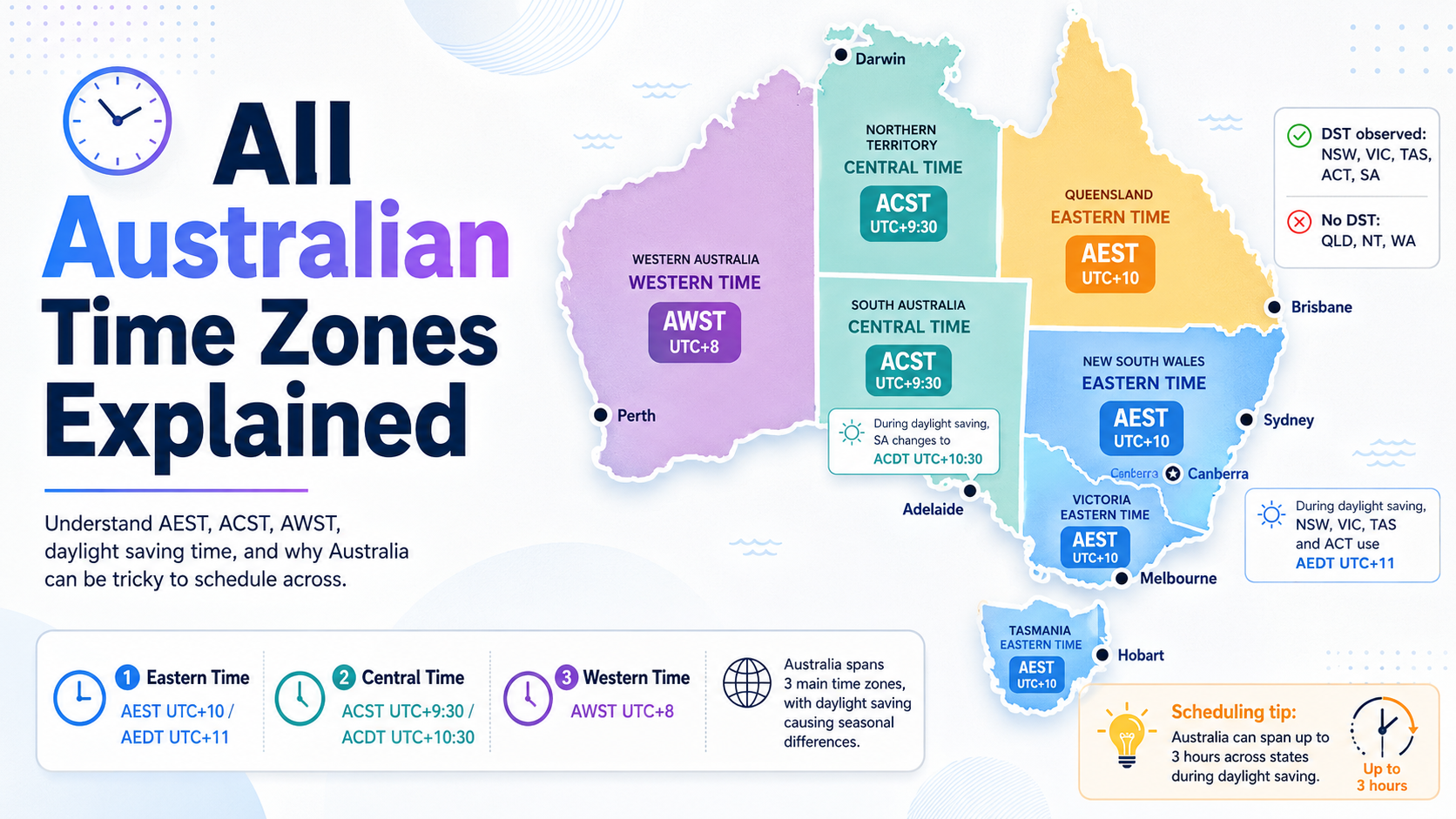
Australia officially spans three main time zones - Eastern, Central, and Western - but with daylight saving variations, you can end up dealing with up to five different offsets at once. Here's the full picture:
| Abbreviation | Full Name | UTC Offset | DST? | States / Territories |
|---|---|---|---|---|
| AEST | Australian Eastern Standard Time | UTC+10 | - | QLD, NSW, VIC, TAS, ACT |
| AEDT | Australian Eastern Daylight Time | UTC+11 | Yes (AEDT) | NSW, VIC, TAS, ACT (not QLD) |
| ACST | Australian Central Standard Time | UTC+9:30 | - | NT, SA |
| ACDT | Australian Central Daylight Time | UTC+10:30 | Yes (ACDT) | SA only (not NT) |
| AWST | Australian Western Standard Time | UTC+8 | No | WA (Perth) |
Australian Eastern Time – AEST and AEDT
The eastern seaboard - New South Wales, Victoria, Tasmania, the ACT, and Queensland - all start on Australian Eastern Standard Time (AEST, UTC+10). But from October to April, New South Wales, Victoria, Tasmania, and the ACT advance their clocks to AEDT (UTC+11) for daylight saving.
Queensland, however, does not. Brisbane stays on UTC+10 year-round. This means that for roughly half the year, Sydney and Brisbane are on the same time - and for the other half, Sydney is one hour ahead. This is a perpetual source of confusion for businesses with offices in both cities.
Australian Central Time – ACST and ACDT
The Northern Territory and South Australia use Australian Central Standard Time (ACST, UTC+9:30). This half-hour offset from the eastern states is one of the quirks that makes Australia's time zone system uniquely complex.
South Australia observes daylight saving and moves to ACDT (UTC+10:30) in summer. The Northern Territory does not observe daylight saving, staying on ACST year-round. This means Adelaide can be ahead of Darwin during Australian summer - two cities in the same base time zone running on different clocks.
Australian Western Time – AWST
Perth and all of Western Australia use Australian Western Standard Time (AWST, UTC+8). Western Australia does not observe daylight saving - a decision confirmed by referendum in 2009 - so Perth is always two hours behind Sydney in winter and three hours behind in Sydney's summer.
Perth is often described as the most isolated major city in the world, and the time zone gap contributes to that sense. An 8 AM morning meeting in Perth is already 11 AM in Sydney. Afternoon calls from Perth often fall outside Sydney's business hours entirely.
Which States Observe Daylight Saving?
Australia's daylight saving season runs from the first Sunday in October to the first Sunday in April - the opposite of the Northern Hemisphere, because Australia's summer falls in December and January.
- Use daylight saving: New South Wales, Victoria, South Australia, Tasmania, ACT
- Do not use daylight saving: Queensland, Western Australia, Northern Territory
The result is a system where the number of distinct Australian time offsets shifts between three (in winter) and five (in summer). For international teams calling into Australia, the gap from London or New York can shift by one hour seemingly at random in late September or early October.
Scheduling Across Australian Cities: The Reality
Let's say you want a 9 AM meeting in Sydney. Here's what time that is for the rest of Australia - during Sydney's daylight saving period (AEDT, UTC+11):
- Sydney (AEDT): 9:00 AM
- Canberra (AEDT): 9:00 AM
- Melbourne (AEDT): 9:00 AM
- Brisbane (AEST, UTC+10): 8:00 AM
- Adelaide (ACDT, UTC+10:30): 8:30 AM
- Darwin (ACST, UTC+9:30): 7:30 AM
- Perth (AWST, UTC+8): 6:00 AM
A single meeting in Sydney can span a three-hour range across the country. Tools like TimezoneHelp's Australia–UK Meeting Planner let you visualise these offsets at once before committing to a time.
Scheduling with Australia?
Compare Sydney, Melbourne, Perth, and Brisbane side by side - then pick the best overlap window.
Frequently Asked Questions
AEST stands for Australian Eastern Standard Time, at UTC+10. It covers Queensland, New South Wales, Victoria, Tasmania, and the ACT during standard (non-daylight-saving) time.
AEDT (Australian Eastern Daylight Time, UTC+11) is used during daylight saving season - roughly October to April. Queensland does not participate and stays on AEST year-round. All other eastern states shift to AEDT in summer.
No. Queensland stays on AEST (UTC+10) year-round. Brisbane and Sydney are on the same time during standard time (April to October), but Sydney moves one hour ahead during daylight saving (October to April).
Perth uses Australian Western Standard Time (AWST, UTC+8). Western Australia does not observe daylight saving, so Perth is always either two or three hours behind Sydney depending on whether Sydney is on AEST or AEDT.
South Australia and the Northern Territory use UTC+9:30 - a 30-minute offset. This dates back to the 1890s when Australian railway companies needed standardised timetables. South Australia chose a compromise offset between its eastern and western neighbours rather than fully aligning with either.