Never get caught by a DST shift again
TimezoneHelp always shows the current offset - DST included.
What Is Daylight Saving Time?
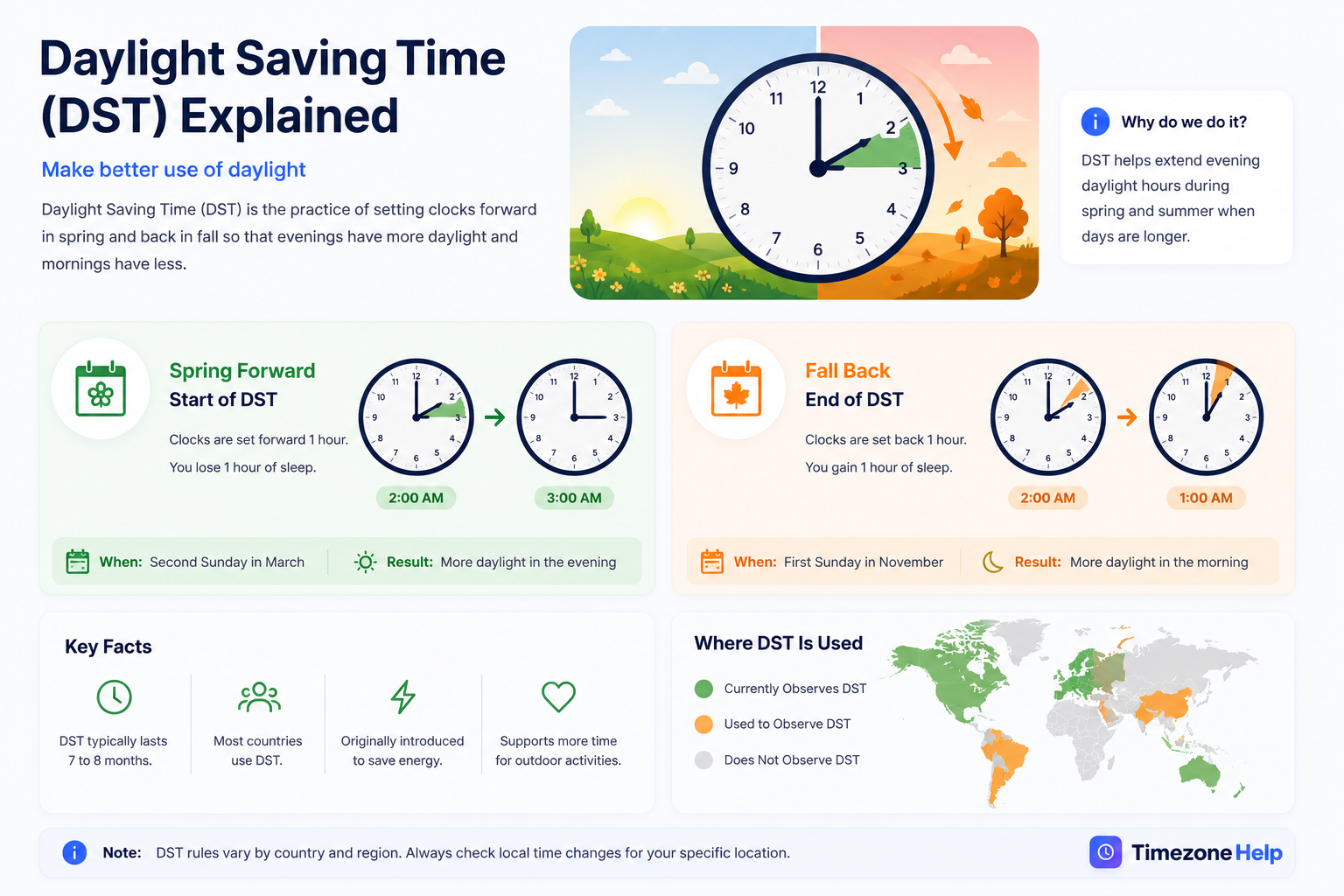
Daylight saving time (DST) is the practice of advancing clocks by one hour during spring and summer months to extend evening daylight. In theory, it lets people enjoy more sunlight after work and reduces energy consumption in the evening hours. In practice, it creates a twice-yearly scramble for anyone who schedules meetings across time zones.
The key problem for international teams is that not every country observes DST - and those that do observe it on different dates. This means the time difference between two cities can temporarily shift by one hour during transition periods, causing meetings to arrive at unexpected times.
The DST Gap: When Countries Change on Different Dates
The classic example is the US–UK offset. In most years:
- The USA typically shifts clocks forward on the second Sunday of March
- The EU (including the UK) typically shifts clocks forward on the last Sunday of March
This creates a roughly two-week window each March where the USA has already moved to summer time but the UK hasn't yet. During this window, the offset between New York and London is four hours instead of five. A team that usually meets "at 10 AM New York / 3 PM London" will find their meeting arriving at 3 PM New York / 3 PM London - no longer staggered at all, and confusing for anyone who relied on the original offset.
DST Transition Dates by Region
| Region | Spring Forward (approximate) | Fall Back (approximate) | Notes |
|---|---|---|---|
| United States | 2nd Sunday, March | 1st Sunday, November | Most states. AZ and HI exempt. |
| European Union | Last Sunday, March | Last Sunday, October | All EU member states |
| United Kingdom | Last Sunday, March | Last Sunday, October | GMT → BST (UTC+1) |
| Australia (some states) | 1st Sunday, October* | 1st Sunday, April* | NSW, VIC, SA, TAS, ACT. *Southern Hemisphere - DST is their summer. |
| New Zealand | Last Sunday, September | 1st Sunday, April | Southern Hemisphere timing |
| Canada | 2nd Sunday, March | 1st Sunday, November | Follows US schedule. Some provinces exempt. |
| India | - | - | No DST. UTC+5:30 year-round. |
| Japan | - | - | No DST. UTC+9 year-round. |
| Singapore | - | - | No DST. UTC+8 year-round. |
| UAE / Dubai | - | - | No DST. UTC+4 year-round. |
Countries That Don't Use Daylight Saving Time
Roughly 70 of the world's ~195 countries observe daylight saving time. The majority do not. Countries near the equator gain little benefit from DST since their daylight hours don't vary much by season - and they typically don't adopt it. Countries that have historically strong agricultural economies, always-on tech sectors, or simply cultural resistance to changing clocks have also abandoned or never adopted DST.
Major countries that do not observe DST:
- India (IST, UTC+5:30) - Never adopted DST. No plans to introduce it.
- Japan (JST, UTC+9) - Abandoned DST after WWII. No discussions of reintroduction.
- China (CST, UTC+8) - Abolished DST in 1991.
- Singapore (SGT, UTC+8) - No DST.
- UAE (GST, UTC+4) - No DST.
- Most of Africa - Only a handful of African countries have ever used DST.
Real-World Scheduling Scenarios
Scenario 1: US team calling London, late October
A US–UK team meets every Monday at 9 AM ET / 2 PM GMT. Then, on the last Sunday in October, the UK moves its clocks back one hour. The following Monday, the meeting calendar still says "9 AM ET / 2 PM" - but 9 AM ET is now 1 PM in London (because the UK has already fallen back). The UK participants now receive a calendar alert for a meeting they think starts at 1 PM but see "2 PM" in the invite. Confusion ensues.
Scenario 2: Sydney calling New York, April
Australia (Sydney) falls back in early April. The US doesn't fall back until November. So from early April through October, the Sydney-to-New-York offset changes: instead of Sydney being 15–16 hours ahead of New York, it drops to 14–15 hours. A team that scheduled "4 PM Sydney / 1 AM New York" now finds the meeting is at midnight instead.
Scenario 3: India calling San Francisco, any time of year
India doesn't observe DST. The US West Coast does. This means the gap between Bangalore and San Francisco changes by one hour in March (when California springs forward) and again in November (when it falls back). The Indian colleagues' meeting time appears to drift by an hour twice a year, even though they haven't moved their clocks at all.
How to Avoid DST Scheduling Mistakes
1. Use a timezone tool that handles DST automatically
Any good scheduling tool - including TimezoneHelp's meeting planner - accounts for DST automatically based on the actual calendar date. Always enter the specific date you're planning for, not just "next Monday at 10 AM," and verify the converted times shown.
2. Create calendar invites with explicit timezone information
When you create a Google Calendar or Outlook event, attach it to a specific timezone (e.g., "America/New_York" rather than "UTC−5"). Calendar applications will then automatically convert the time for attendees in other zones - and will shift the displayed time correctly when DST transitions occur.
3. Double-check around transition weekends
Build a reminder to verify recurring meetings during the following periods each year:
- Early March - US springs forward
- Late March - EU/UK springs forward
- Early April - Australia falls back
- Late October - EU/UK falls back
- Early November - US falls back
Any recurring meeting that spans a DST boundary deserves a quick check in the days before the transition.
4. Consider scheduling in UTC for global teams
For teams spanning multiple DST-observing and non-DST countries, scheduling in UTC eliminates the confusion entirely. A meeting at "14:00 UTC" is 14:00 UTC regardless of what any individual country's clocks are doing. Each person converts to their own local time - and timezone tools handle that conversion accurately, including DST.
Will DST Be Abolished?
Multiple governments have proposed or begun the process of abolishing DST. The EU voted to end seasonal clock changes, though implementation stalled on which permanent time to adopt. Several US states have passed legislation to stay on permanent summer time - but federal law currently prevents the switch without Congressional approval.
Until DST is abolished uniformly, international teams need to account for clock changes as a fact of scheduling life. The good news: timezone tools that take dates into account - like the ones on TimezoneHelp - handle all of this automatically, so you don't need to memorise which countries change when.
Never miss a meeting because of clock changes
TimezoneHelp accounts for DST automatically. Enter a date, pick a time, and see every participant's local time - including during DST transitions.
Frequently Asked Questions
No. Only about 70 countries observe daylight saving time. Most countries near the equator and many others - including India, Japan, China, Singapore, and most of Africa - do not use DST. Hawaii and most of Arizona in the USA are also exempt.
Different countries change their clocks on different dates. The USA typically changes in early March; the EU changes in late March; Australia changes in April. This creates 2–4 week windows each year where the offset between any two countries is temporarily one hour different from its usual value, causing meetings to arrive at unexpected times.
No. India stays on India Standard Time (IST, UTC+5:30) year-round and has never observed daylight saving. This means the offset between India and DST-observing countries like the USA and UK changes by one hour twice a year - with India staying fixed while the other country moves.
It varies by country. The USA begins on the second Sunday in March; most EU countries begin on the last Sunday in March; Australia (Southern Hemisphere) begins in early October. The exact dates shift by a week or two from year to year, so always verify for the specific year you're scheduling in.
Use a timezone tool that accounts for DST based on the actual calendar date. Create calendar invites with explicit timezone names (not UTC offsets) so your calendar app handles transitions automatically. Set recurring reminders to check meetings during the DST transition weekends in March, October, and November.