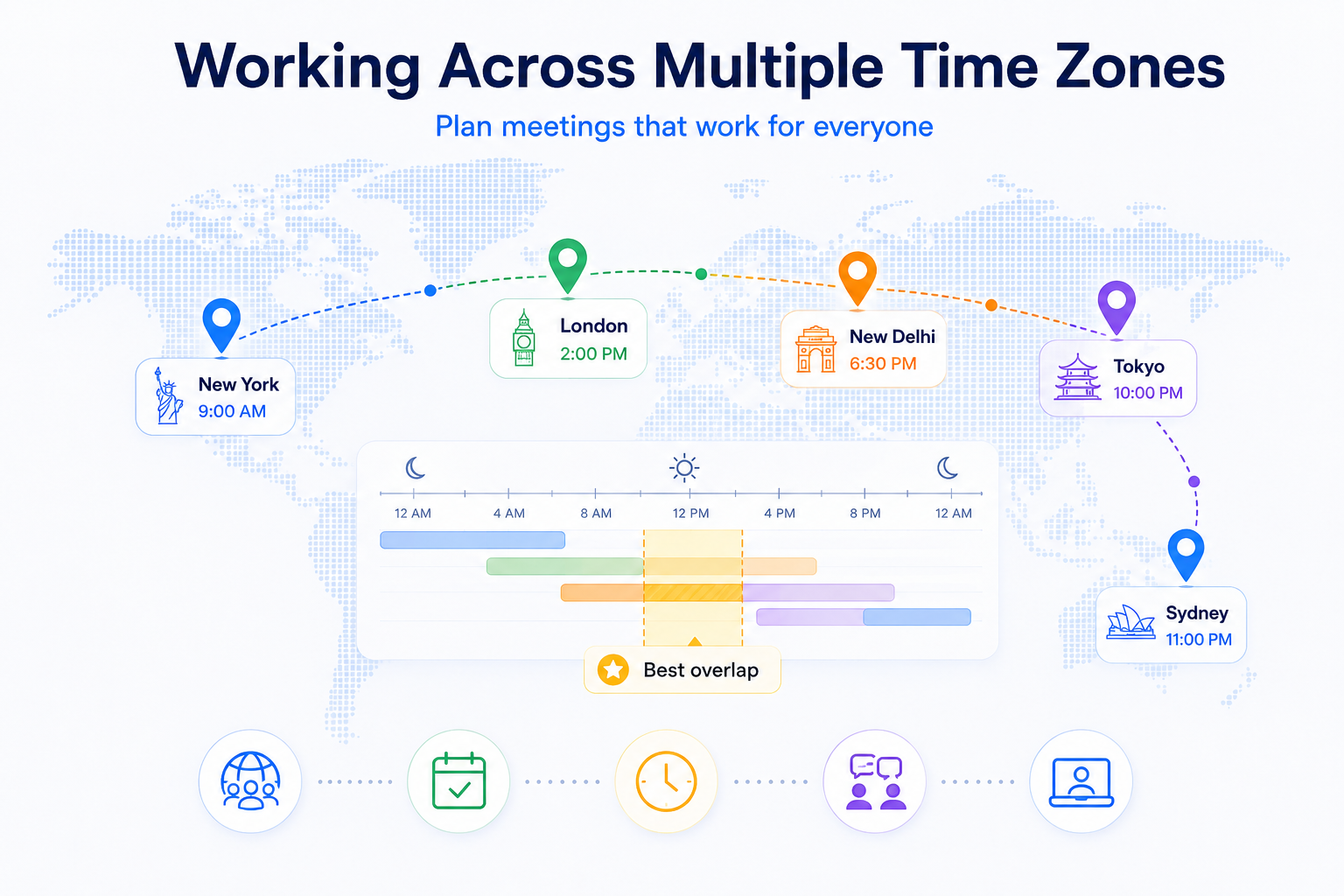
Compare any two countries instantly
Find overlapping work hours across cities worldwide.
Why Do Multiple Time Zones Exist?
The reason is geometric: the Earth takes 24 hours to complete one full 360-degree rotation. That's exactly 15 degrees per hour. Any country that spans more than 15 degrees of longitude will experience meaningfully different sunrise and sunset times at its east and west ends.
Without multiple time zones, a country like Russia would have cities in the far east waking up at sunrise while Moscow was still in the middle of the night - yet both would show the same clock time. Time zones align official clocks with actual daylight, keeping work schedules, school hours, and daily routines in sync with the sun.
Russia: 11 Time Zones
Russia is the world's largest country by land area, stretching approximately 9,000 kilometres from its western border with Finland to the Bering Strait in the far east. It spans 11 official time zones - from UTC+2 (Kaliningrad, a Russian exclave in Europe) to UTC+12 (Kamchatka and Chukotka).
When it's Monday morning in Moscow, it's already late Monday evening in Kamchatka. Coordinating a phone call across the full length of Russia means navigating a 10-hour gap. Domestic flights between western and eastern Russia can involve crossing five or six time zones - the equivalent of flying across the entire continental United States and then some.
| Region | Time Zone Name | UTC Offset |
|---|---|---|
| Kaliningrad | Kaliningrad Time (KALT) | UTC+2 |
| Moscow, St. Petersburg | Moscow Time (MSK) | UTC+3 |
| Samara, Udmurtia | Samara Time (SAMT) | UTC+4 |
| Yekaterinburg | Yekaterinburg Time (YEKT) | UTC+5 |
| Omsk | Omsk Time (OMST) | UTC+6 |
| Krasnoyarsk | Krasnoyarsk Time (KRAT) | UTC+7 |
| Irkutsk | Irkutsk Time (IRKT) | UTC+8 |
| Yakutsk | Yakutsk Time (YAKT) | UTC+9 |
| Vladivostok | Vladivostok Time (VLAT) | UTC+10 |
| Magadan | Magadan Time (MAGT) | UTC+11 |
| Kamchatka, Chukotka | Kamchatka Time (PETT) | UTC+12 |
United States: 6+ Time Zones
The continental USA uses four time zones. Add Alaska and Hawaii and you reach six - plus additional offsets for territories like Puerto Rico, Guam, and American Samoa. The continental span alone (Eastern to Pacific) is three hours, meaning a live TV event that airs at 9 PM on the East Coast reaches the West Coast at 6 PM.
For remote teams, this creates a manageable but real constraint. An "afternoon" meeting in New York is a "morning" meeting in California. Zoom fatigue aside, scheduling across coasts often requires compromise - usually a mid-morning Eastern window that's still early-but-reasonable on the West Coast.
Read more: All US Time Zones Explained
Canada: 6 Time Zones
Canada spans six time zones from east to west - from Newfoundland Standard Time (UTC−3:30) in the Atlantic to Pacific Time (UTC−8) in British Columbia. Notably, Newfoundland and Labrador use a half-hour offset (UTC−3:30 in winter), making it one of only a handful of jurisdictions worldwide to use a non-standard 30-minute increment.
Canada's geography creates a scenario where a breakfast meeting in Vancouver (8 AM PT) is a late lunch meeting in St. John's (12:30 PM NST) - a 4.5-hour gap within a single country.
Australia: 3 to 5 Effective Time Zones
Australia officially uses three main time zones - Eastern, Central, and Western - but the patchwork of daylight saving rules across states creates up to five distinct offsets during summer months. South Australia and the Northern Territory both observe Central Time (UTC+9:30) in winter, but South Australia moves to UTC+10:30 for daylight saving while the NT stays fixed.
The result is a country where a single "conference call across Australia" can require checking five different clocks. Read more: Australian Time Zones Explained
Brazil: 4 Time Zones
Brazil, the largest country in South America, spans four time zones ranging from UTC−2 (the island of Fernando de Noronha) to UTC−5 (the western Amazon states of Acre and Amazonas). The main population centres - São Paulo, Rio de Janeiro, Brasília - use Brasília Standard Time (BRT, UTC−3).
Brazil's approach to daylight saving has been inconsistent - the country has observed it selectively and even abolished it entirely in 2019. This makes Brazil one of the trickier countries for international scheduling, as the offset from other countries has changed more than once in recent years.
China: One Time Zone, One Country
China is notable for going the opposite direction: despite spanning roughly five natural time zones by longitude (from UTC+5 to UTC+9), the entire country officially uses a single time zone - China Standard Time (CST, UTC+8).
This was a political decision made in 1949 to unify the country under a single clock. The practical result is that in western Xinjiang, the sun doesn't rise until 9 or 10 AM by official clock time, and doesn't set until 9 or 10 PM - the entire daily schedule is shifted by several hours compared to what feels natural for the region's latitude and longitude.
France: The Most Time Zones (By Territory)
While Russia has the most time zones on contiguous land, France holds a technical record when overseas territories are counted: French Polynesia, French Guiana, Réunion, Martinique, and others push France's total to 12 distinct time zones - more than any other country in the world when overseas territories are included.
Multi-Timezone Countries at a Glance
| Country | Time Zones (mainland) | Total Span |
|---|---|---|
| Russia | 11 | 10 hours |
| USA | 6 | 6 hours (incl. territories) |
| Canada | 6 | 4.5 hours |
| Australia | 3–5 (incl. DST) | 3 hours |
| Brazil | 4 | 3 hours |
| China | 1 (official) | 0 (political decision) |
| India | 1 (UTC+5:30) | 0 (single zone) |
Compare cities across any country
TimezoneHelp lets you compare multiple cities simultaneously to find the best meeting window across any combination of countries.
Frequently Asked Questions
Russia spans 11 time zones on its mainland, making it the country with the most contiguous time zones. France technically covers 12 when overseas territories are included, but Russia holds the record for mainland span.
The USA has six primary time zones: Eastern, Central, Mountain, Pacific, Alaska, and Hawaii-Aleutian. US territories (Puerto Rico, Guam, American Samoa, etc.) use additional offsets, pushing the total beyond six.
Australia spans roughly the same east-west distance as the continental USA. Different parts of the country experience sunrise and sunset at very different times, so separate time zones keep daily schedules aligned with daylight. Inconsistent daylight saving rules across states add further complexity.
Officially, no. China uses a single time zone nationwide (UTC+8) despite spanning five natural time zones by longitude. This was a political decision made in 1949. In practice, western regions like Xinjiang operate on an unofficial "Xinjiang time" that's two hours behind Beijing.
Time zones ensure local time aligns with daylight - keeping work hours, school schedules, and daily routines in sync with the actual time of day. For international scheduling, understanding time zone offsets is essential to avoid booking meetings in the middle of someone's night or very early morning.