Compare US time zones instantly
Find the best meeting time across US cities.
The Six Major US Time Zones
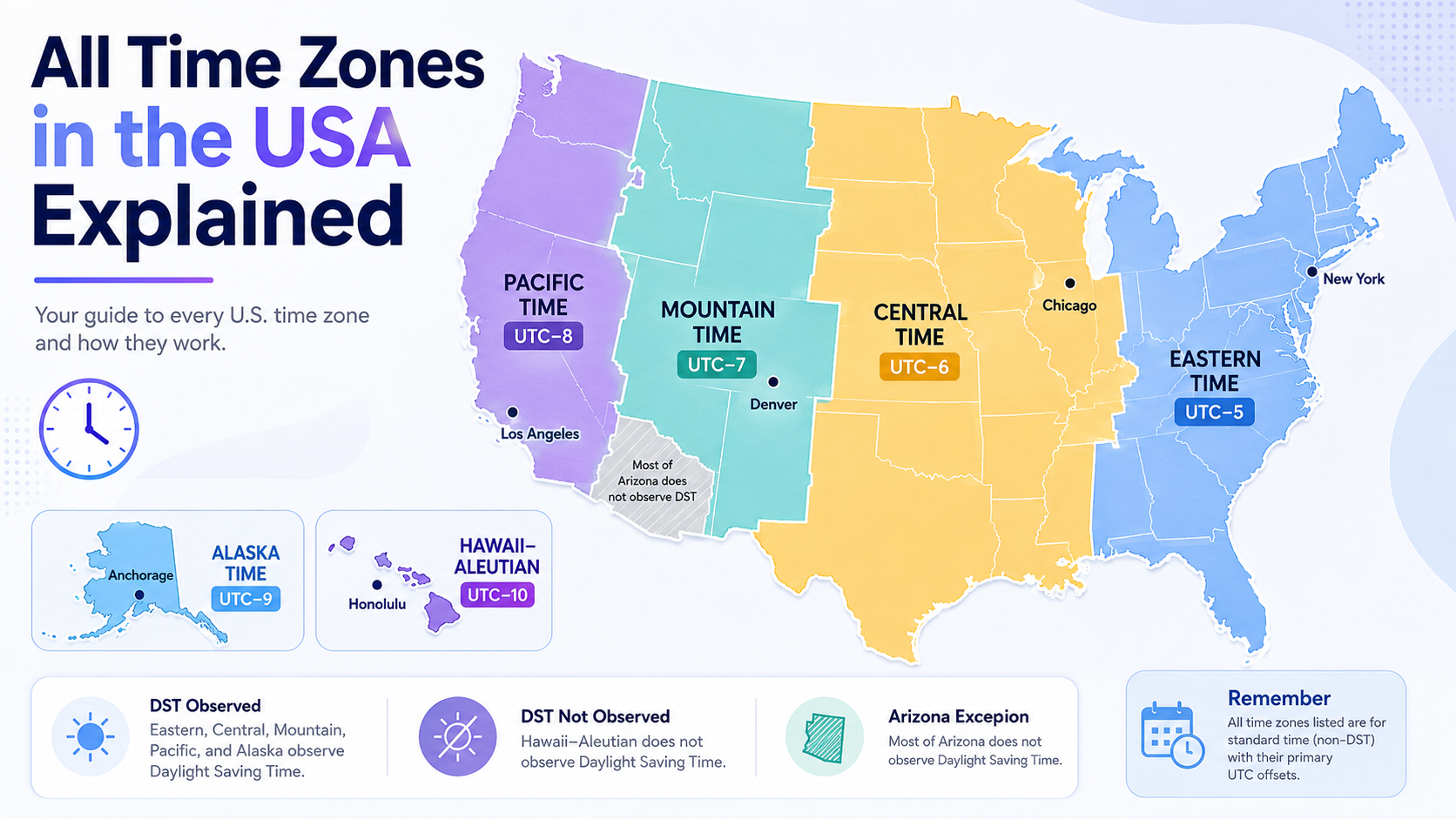
The continental United States uses four time zones. Add Alaska and Hawaii and you reach six distinct offsets - plus additional territories that follow their own rules. Here's a breakdown of each one.
| Time Zone | Abbreviation | Standard (Winter) | Daylight Saving | Key Cities |
|---|---|---|---|---|
| Eastern Time | ET | UTC−5 | UTC−4 | New York, Miami, Atlanta |
| Central Time | CT | UTC−6 | UTC−5 | Chicago, Dallas, Houston |
| Mountain Time | MT | UTC−7 | UTC−6 | Denver, Salt Lake City |
| Pacific Time | PT | UTC−8 | UTC−7 | Los Angeles, Seattle, SF |
| Alaska Time | AKT | UTC−9 | UTC−8 | Anchorage, Fairbanks |
| Hawaii–Aleutian | HAT | UTC−10 | No DST | Honolulu |
Eastern Time (ET)
Eastern Time covers roughly a third of the US population and is the dominant time zone for finance, media, and federal government. Major exchanges like the NYSE open at 9:30 AM ET. The White House, Congress, and most major television networks all operate on Eastern Time, which means ET sets the rhythm for much of national life.
In winter, ET is UTC−5 (EST). During daylight saving time from March to November, clocks move to UTC−4 (EDT). States fully on Eastern Time include New York, Florida, Georgia, Pennsylvania, Ohio, and more than a dozen others.
Central Time (CT)
Central Time covers the broad middle band of the country - from the Canadian border in the north to the Gulf of Mexico in the south. Chicago is the economic hub of this zone, and CT is closely tied to manufacturing, agriculture, and logistics.
CT runs one hour behind ET: when it's noon in New York, it's 11 AM in Chicago. Major states on Central Time include Illinois, Texas, Minnesota, Wisconsin, and Missouri. Parts of states like Indiana, Kentucky, and Nebraska observe Central instead of Eastern due to geographic and economic ties.
Mountain Time (MT)
Mountain Time spans the Rocky Mountain region, running two hours behind Eastern. It's a notable zone for a specific reason: Arizona (except the Navajo Nation) does not observe daylight saving time. This means Arizona stays at UTC−7 year-round, while most of the Mountain zone shifts between UTC−7 and UTC−6.
This creates a situation where, for part of the year, Arizona is on the same time as California - and for the other part, it matches New Mexico. It's one of the most common sources of scheduling confusion in the western US.
Pacific Time (PT)
Pacific Time is the home of Silicon Valley, Hollywood, and the Pacific Northwest tech corridor. It runs three hours behind Eastern Time in winter and during daylight saving. For global companies headquartered in California, scheduling meetings with New York (3-hour gap), London (8-hour gap), and Asia (around 16-hour gap) requires careful planning.
Key cities: Los Angeles, San Francisco, Seattle, Portland, Las Vegas. The western most point of the contiguous US - Cape Flattery in Washington - is on Pacific Time.
Alaska Time (AKT)
Alaska observes its own time zone, running one hour behind Pacific Time. Most of Alaska's population lives in the south-central region, centered on Anchorage, which sits at roughly UTC−9 in winter. Alaska does observe daylight saving time, shifting to UTC−8 in summer, making it align temporarily with Pacific Standard Time.
The Aleutian Islands chain has its own wrinkle - the western Aleutians technically cross the International Date Line, but for practical purposes they stay on Hawaii-Aleutian Time.
Hawaii–Aleutian Time (HAT)
Hawaii is the only US state that shares a time zone with no other states. The Hawaiian Islands sit at UTC−10, and crucially, Hawaii does not observe daylight saving time. This means the offset between Hawaii and the mainland shifts by an hour depending on the time of year.
When California is on PST (winter), Hawaii is 2 hours behind. When California shifts to PDT (summer), Hawaii becomes 3 hours behind. For businesses connecting Hawaii with mainland offices, this seasonal drift is worth keeping in mind.
Why US Time Zones Matter for Remote Teams
With a four-hour spread across the continental US alone, scheduling all-hands meetings that work for everyone requires deliberate planning. A 9 AM standup in New York lands at 6 AM in San Francisco - functional but uncomfortable. A 3 PM call in Los Angeles is 6 PM in New York - after hours for East Coast teammates.
The sweet spot for pan-US meetings is typically 11 AM–2 PM Eastern / 8 AM–11 AM Pacific. This keeps everyone inside normal business hours with no one starting too early or finishing too late. When you add international participants from London, India, or Sydney, the calculation gets considerably more complex.
US Territories
Beyond the 50 states, US territories add further complexity:
- Puerto Rico & US Virgin Islands - Atlantic Time (UTC−4), no daylight saving. Same as Eastern Daylight Time in summer.
- Guam & Northern Mariana Islands - Chamorro Standard Time (UTC+10), no daylight saving.
- American Samoa - Samoa Standard Time (UTC−11), no daylight saving.
This means a single US government or multinational company with offices from Guam to Hawaii to Puerto Rico can span up to 21 hours across its locations - nearly a full day.
Need to compare US time zones right now?
Use TimezoneHelp to compare any US city combination instantly and find the best meeting time.
Frequently Asked Questions
The USA has six primary time zones across its states and territories: Eastern, Central, Mountain, Pacific, Alaska, and Hawaii-Aleutian. US territories add even more - Guam and American Samoa each use their own offsets.
No. Hawaii and most of Arizona do not observe daylight saving time. All other states follow the standard spring-forward, fall-back schedule - clocks move forward one hour in March and back one hour in November.
The continental US spans exactly three hours between Eastern and Pacific time. If you include Hawaii (UTC−10), the gap from the East Coast in summer (UTC−4 on EDT) reaches six hours.
New York uses Eastern Time (ET), which is UTC−5 in winter (EST) and UTC−4 during daylight saving time from March to November (EDT).
California uses Pacific Time (PT), which is UTC−8 in winter (PST) and UTC−7 during daylight saving time (PDT).